About This Topic
In Japan today, shrines and temples may look clearly separated.
Shrines have torii gates, kami, and Shinto rituals.
Temples have Buddhist statues, incense, and monks.
But for much of Japanese history, Shinto and Buddhism were not so neatly divided.
The Japanese terms may look difficult at first, but the basic idea is simple.
Shinbutsu means “kami and Buddhas.”
Shūgō means “blending” or “coming together.”
Bunri means “separation.”
So, shinbutsu-shūgō means the blending of kami worship and Buddhism, while shinbutsu-bunri means their separation.
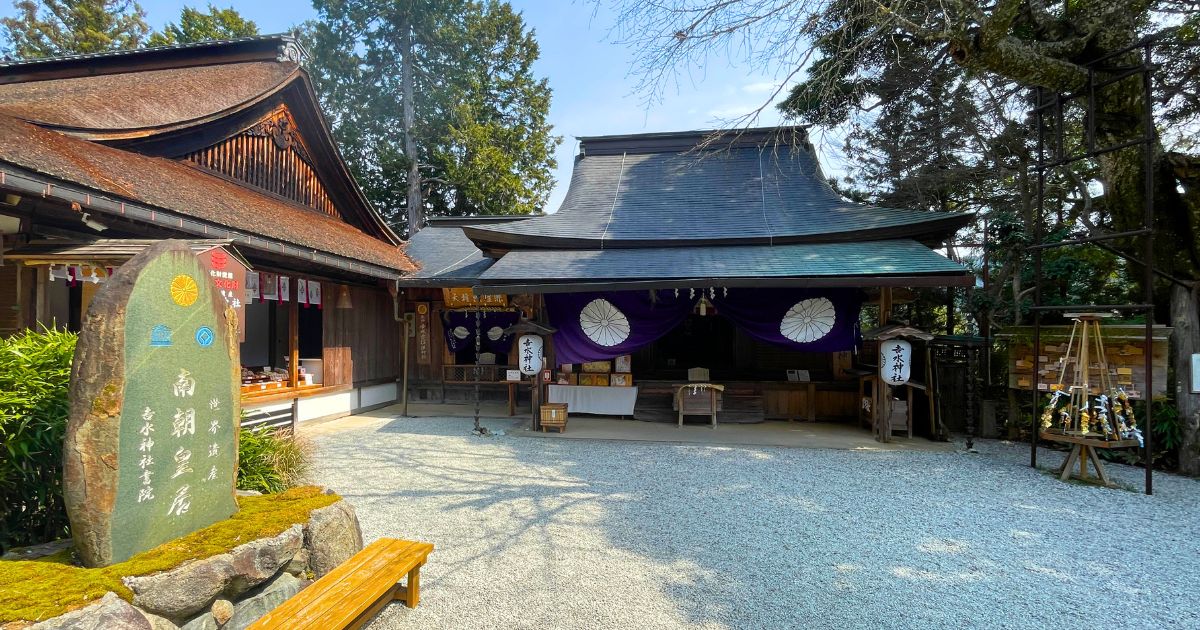
Once you know this, many things in Japan begin to make more sense: a torii gate at a temple, a Buddhist figure connected with a shrine, or a sacred place that seems to carry more than one tradition.
These are not always contradictions.
They may be traces of Japan’s layered religious history.
When Shinto and Buddhism Came Together
Buddhism was introduced to Japan in the 6th century.
But it did not simply replace older kami worship.
Instead, Buddhism gradually became connected with Shinto.
By the Nara period, temples were sometimes built near shrines, and kami were understood as protectors of Buddhism.
Later, in the medieval period, this relationship became even deeper.
One important idea was honji suijaku.
In simple terms, this idea saw Buddhas and bodhisattvas as the original forms, while kami were their local appearances in Japan.
You do not need to remember the theory perfectly.
The important point is that, for many centuries, kami and Buddhas were often understood together.
Shrines and temples could share the same sacred space.
People could pray to both without feeling that they had to choose only one.
Why Could They Be Blended?
Shinto did not begin with one founder, one scripture, or one fixed doctrine.
It grew through kami, nature, rituals, local communities, ancestors, and sacred places.
Because of this, Shinto often had room to receive new beliefs and ideas.
A new religion did not always have to erase what came before.
It could be placed beside it.
It could be reinterpreted.
It could become part of the local sacred landscape.
Of course, Japanese religious history was not always peaceful or simple.
There were political conflicts and moments of tension.
Still, Japanese religious culture often developed through layering rather than complete rejection.
That is one reason many people in Japan have long visited both shrines and temples.
A shrine visit and a temple visit were not always seen as opposing acts.
They were different ways of facing prayer, gratitude, protection, death, memory, and daily life.
Deities from Beyond Japan
This openness also allowed beings from outside Japan to become part of Japanese religious life.
One clear example is Benzaiten, known in Japan as a deity connected with music, eloquence, water, fortune, and the arts.
Benzaiten has roots in the Indian goddess Sarasvatī and came to Japan through Buddhism.
At places such as Enoshima, Benzaiten became deeply connected with local kami worship.
This does not mean that everything was mixed without meaning.
Rather, different layers were added over time.
A deity could come from India, be carried through Buddhism, become connected with Japanese religious soil, and take root within local worship.
The sacred world in Japan was not always built with hard borders.
It often grew through connection.
When Shinto and Buddhism Were Separated
Shinbutsu-bunri, the separation of Shinto and Buddhism, began in the early Meiji period, especially from 1868.
After the Meiji Restoration, the new government wanted to build a modern nation-state and reorganize religious institutions.
Shinto rituals connected with the emperor were given a central role.
In that process, the older mixed world of shrines and temples was seen as something that needed to be separated.
Buddhist elements were removed from many shrines.
Buddhist statues, bells, temple buildings, Buddhist names, and Buddhist rituals connected with shrines were separated or abolished.
In some regions, this became much more extreme.
The movement known as haibutsu kishaku led to the destruction of Buddhist statues, temples, and objects.
It is helpful to separate the two terms.
Shinbutsu-bunri was the government policy of separating Shinto and Buddhism.
Haibutsu kishaku was the anti-Buddhist destruction that spread in some areas under that influence.
They are closely connected, but they are not exactly the same.
Why the Separation Happened
The reason was not only religious.
It was also political.
The Meiji government wanted a clearer national structure centered on the emperor and Shinto ritual.
Before this, many sacred places had both shrine and temple elements.
After shinbutsu-bunri, many of them were pushed to become more clearly either a shrine or a temple.
This is why some shrines today look very purely Shinto, even if their older history included Buddhist elements.
The clear separation many people imagine today is actually quite modern.
For much of Japanese history, the boundary was softer.
What Remains Today
Even after shinbutsu-bunri, the older layers did not completely disappear.
Some shrines still have traces of Buddhist influence.
Some temples still have small shrines or torii gates.
Local festivals, place names, legends, and customs may also preserve memories of shinbutsu-shūgō.
Enoshima is one example.
Today, Enoshima Shrine is a Shinto shrine, but the faith in Enoshima Benzaiten still remains strong.
This shows that religious history does not disappear simply because a policy changes.
People remember.
Places remember, too.
Sometimes the older layers remain quietly, in a name, a small building, a festival, or a story told in the area.
Final Thoughts
Shinbutsu-shūgō shows how Shinto and Buddhism were brought together over many centuries.
Shinbutsu-bunri shows how they were separated in the modern period.
Together, they remind us that Japanese sacred places are not always easy to explain with simple categories.
Shrine or temple.
Kami or Buddha.
Old or new.
Sometimes the answer is not one side or the other.
Sometimes, the meaning is found in the layers.