A Faith Before It Had a Name
Shinto did not begin with a single founder.
It did not begin with one book, one doctrine, or one person declaring a new religion.
Its roots are older and quieter than that.
Before the word Shinto became common, and before Japan became a country in the later historical sense, people in the Japanese islands had already lived with a deep awareness of nature, life, death, ancestors, and unseen presence.
This does not mean that Shinto, as a defined religious concept, already existed in the Jomon period.
Rather, the Jomon period shows us something older: ritual places, spiritual practices, and a way of sensing the sacred in the world.
That ancient feeling did not disappear.
Over a long time, it became part of the foundation of what we now call Shinto.
The Ancient Roots of Nature Worship
The Jomon period left many traces of ritual life.
Across different parts of Japan, archaeologists have found places that seem to have been used for ceremonies, burials, and spiritual practices.
Stone circles are one example.
These were not shrine buildings in the later sense.
They were not Shinto shrines as we know them today.
But they show that people were already gathering in special places, facing life, death, nature, and the unseen with ritual attention.
This is important.
The roots of Shinto are not found in a single moment when a religion was officially created.
They are found in older human feelings.
Gratitude for nature.
Fear of natural forces.
Respect for ancestors.
A sense that the visible world is not empty.
These feelings existed long before Shinto had a name.
Nature as a Place of Sacred Presence
In ancient Japan, nature was not only scenery.
Mountains, rocks, trees, waterfalls, rivers, the sea, the sun, wind, and rain were part of life itself.
Nature gave food and water.
It brought beauty and seasons.
But it also brought storms, earthquakes, floods, droughts, and fire.
Because of this, people did not see nature only as something to use.
They felt awe.
They felt gratitude.
They felt fear.
They sensed that powerful, invisible forces moved through the world.
In later Shinto, these sacred presences came to be called kami.
Kami are not simply “gods” in the Western sense.
They can be felt in nature, ancestors, remarkable places, and things that inspire reverence.
In Japan, people have long spoken of Yaoyorozu no Kami (the countless kami). Yaoyorozu literally means “eight million,” but it is used to mean “countless” or “a great many.” This phrase expresses the idea that sacred presence can dwell in, or be revealed through, all kinds of things in the world.
This way of seeing the world is one of the oldest layers beneath Shinto.
Mountains, Rocks, and the Sacred Place
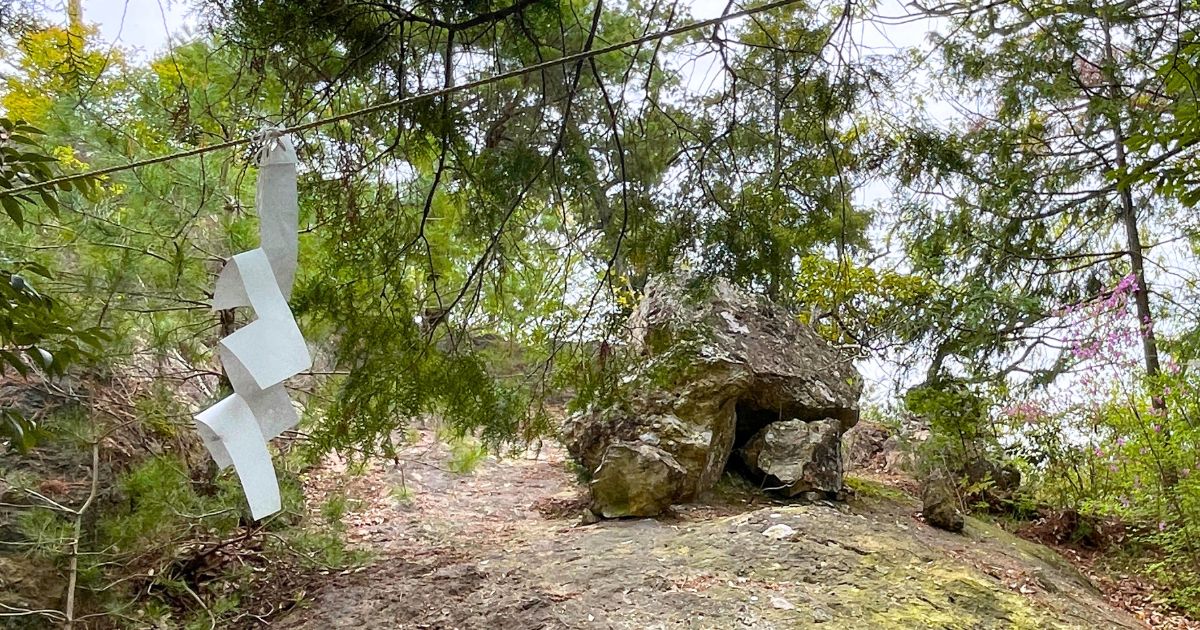
In early forms of worship, a shrine building was not always necessary.
A mountain itself could be sacred.
A great rock could be sacred.
An ancient tree could be sacred.
Ōmiwa Jinja is one of the clearest examples of this ancient feeling.
Ōmiwa Jinja (a shrine in Nara Prefecture that worships Mount Miwa as its sacred object) preserves a form of worship in which the mountain itself is revered as the place of the kami.
At Ōmiwa Jinja, Mount Miwa is not simply a background landscape.
It is the sacred object of worship.
This reminds us that the sacred place came before the shrine building.
People first sensed presence in the mountain, the rock, the forest, or the land.
The formal structure of the shrine came later.
This same feeling can also be seen in ancient rock worship.
A stone was not always just a stone.
A mountain was not always just a mountain.
Some places were approached with care because people felt that something sacred was there.
Shinto Was Not Created to Rule People
Shinto was not originally created as a religion for governing a nation.
It was not designed by one ruler to control the people.
Its roots are older than the formation of Japan as a centralized state.
Of course, as Japan developed, kami worship and shrine rituals became connected with local communities, ruling families, the imperial court, and the state.
History is never completely separate from power.
But that is not the same as saying Shinto began as a political tool.
At its deepest root, Shinto grew from people’s relationship with the world around them.
People gave thanks for harvests.
They feared disaster.
They honored ancestors.
They prayed for protection.
They purified themselves before approaching sacred places.
These were not abstract doctrines.
They were ways of living.
No Founder, No Scripture
Many religions begin with a founder.
Shinto does not.
Many religions have a central scripture that defines doctrine.
Shinto does not have that either.
There are important ancient texts such as the Kojiki and the Nihon Shoki.
These preserve myths, genealogies, and early traditions.
But they are not scriptures in the same way as the Bible or the Qur’an.
Shinto was passed down through ritual, festival, seasonal practice, local tradition, and community memory.
It was learned by doing.
By bowing.
By offering.
By purifying.
By celebrating the harvest.
By visiting sacred places at important moments of life.
This is why Shinto can feel difficult to explain in one sentence.
It is not built around one fixed doctrine.
It is carried through practice.
A Faith That Grew from the Human Heart
Shinto was not invented all at once.
It grew naturally from the human heart.
People looked at the world and felt gratitude.
They felt awe.
They felt fear.
They felt that life was supported by forces beyond human control.
From that feeling, worship began.
A waterfall was not just water.
A mountain was not just stone and trees.
A harvest was not only the result of human labor.
Behind these things, people sensed presence.
Over time, those feelings became rituals.
Rituals became traditions.
Traditions became shrines, festivals, prayers, and ways of honoring kami.
This is how the ancient sense of reverence came to live inside Shinto.
Not as something suddenly invented.
But as something slowly shaped by countless lives.
The Spirit of Shinto
If we try to describe the heart of Shinto, it may be this:
To live with reverence.
To receive nature’s blessings with gratitude.
To approach sacred places with purity.
To remember ancestors.
To honor the unseen presence within the visible world.
Shinto is not a religion of one founder’s words.
It is not a religion of one book.
It is a path shaped by countless acts of reverence over a very long time.
This is one reason many people in Japan do not necessarily feel Shinto as a “religion” in the Western sense. And yet, they often live within customs, manners, and values shaped by Shinto’s ideals.
A person bows before a shrine.
A family gives thanks for a child’s growth.
A village celebrates the harvest.
A mountain is approached with care.
A tree is protected because it feels sacred.
These small acts are not separate from Shinto.
They are Shinto.
Final Thoughts
Shinto did not exist in the Jomon period as a fully formed religious system with that name.
But the Jomon period shows us an older spiritual world: ritual places, reverence for nature, attention to life and death, and a sense that human life was connected to forces beyond the visible.
That ancient way of feeling the world became part of the soil from which Shinto later grew.
Shinto was not created to control people.
It was not founded by one person.
It does not rest on one scripture.
Instead, Shinto lives in the relationship between humans, nature, community, ancestors, and kami.
That is why it can feel simple and difficult at the same time.
Simple, because it begins with gratitude and reverence.
Difficult, because it cannot be reduced to a single doctrine.
Shinto is not only something to be explained.
It is something to be felt.
In the sound of wind through trees.
In the stillness before a shrine.
In the mountain that has been worshipped since ancient times.
And in the quiet bow of a person standing before the unseen.